City‑Wide Local SEO Success Without an Agency: Tools, Costs, Results
How I Took a Design First Website and Ranked It Above My Competitors Across My City
A Real Local SEO Case Study (No Hype, Just What Worked)
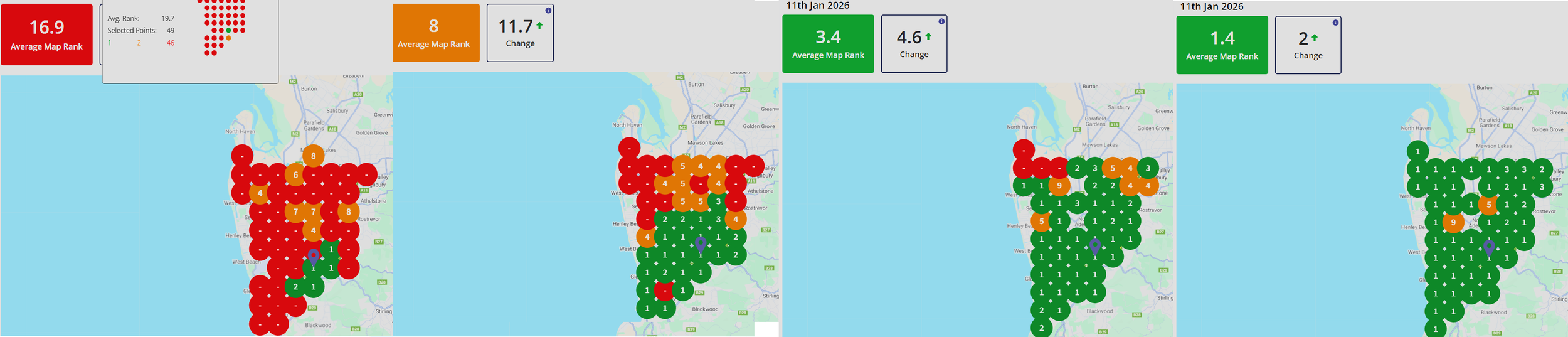
Over the past few months, I’ve managed to rank above my competitors across my city for my key service areas including breaking into the top three Google Map Pack results, where the majority of calls and enquiries actually happen.
What makes this story worth sharing is that it didn’t start with “perfect SEO”, and it definitely didn’t start with a big budget.
In fact, it started with a website that was built for humans only, with almost no thought given to search engines at all.
Just a Snippet of what we managed to do:
Where It All Started: The Original Website (Circa 2021)
The original website for Tech1Solutions was created around 2021.
At the time, the goal was very clear:
Make the site look professional
Write content that felt natural and conversational
Appeal to real people, not algorithms
Get ourselves onto Google and Bing
And to be fair it did look good.
However, there was very little SEO strategy involved:
No structured keyword targeting
No service‑specific SEO pages
No local landing pages
No thought given to how Google understands, categorises, or ranks content
The site was designed around human conversation and aesthetics, without considering how a search engine “reads” a website.
Find to find us, you already knew us, and that, is very backwards, you as business owners put energy and time into these tools to get found.
This is extremely common — and it’s not wrong — but it does limit how far a site can rank competitively.
Taking Ownership: Gradual SEO Improvements (Without Spending Money)
I took over looking after the website around two years later.
Even then, SEO wasn’t an overnight priority. My initial focus was simply making sure:
The site made sense structurally
Core service information was clear
Pages weren’t actively working against rankings
I spent time doing basic SEO improvements, including:
Improving page titles and headings
Cleaning up service descriptions
Making sure the website aligned properly with our Google Business Profile
Ensuring the business location and services were clearly referenced
Importantly:
This was all done without spending money on tools or services.
At this stage, the results were modest but meaningful.
We started:
Appearing on the front page of Google
Ranking for relevant local service terms
Getting visibility through the Google Business Profile
However, we were not consistently in the top three, especially in the map pack.
The Plateau: Front Page, But Not Top 3
This is a point many local businesses get stuck at.
We were visible. We weren’t invisible. But we also weren’t winning.
Being:
Positions 4–10
Just below the map pack
On the “front page”, but not getting the bulk of clicks
…means you’re close, but not close enough.
And at that point, it became clear that:
Doing “a bit of SEO” wasn’t going to move the needle any further.
The Reality of Using a Design Centric Website Builder for SEO
The website was built using a design‑centric website builder, where the primary focus is visual layout, ease of use, and human‑friendly content — not search engine performance.
That isn’t a criticism. In fact, these platforms are extremely good at what they’re designed to do:
Fast deployment
Clean, modern design
Content that reads naturally to real users
Low barrier to entry for non‑developers
However, the trade‑off is that SEO is rarely front‑of‑mind during the build process.
Where Design First Builders Typically Fall Short for SEO
In our case, the original site reflected a very common pattern:
Pages were written like conversations, not search intent targets
Services were grouped together instead of broken into distinct, indexable pages
Headings were used for styling, not structure
Internal linking existed visually, but not strategically
There was little consideration for how Google categorises and understands pages
From a human perspective, the site made sense.
From a search engine perspective, the signals were weak.
This is not unique to our website, it’s a common outcome when a site is built primarily for appearance and messaging, with SEO treated as an afterthought.
SEO Isn’t Blocked on Design Centric Platforms. It Just Requires Intention.
One of the biggest misconceptions is that design centric website platforms “can’t rank”.
That simply isn’t true.
The limitation isn’t the platform itself it’s how the platform is used.
SEO and online visibility have been around for a long time and have evolved into a specialised skillset. Like any developed skill, effective SEO relies on multiple tools, deliberate structure, and ongoing refinement. No single website builder regardless of how polished or user‑friendly it is can replace that process on its own.
Design centric platforms excel at appearance and usability, but they don’t automatically handle search intent, local relevance, or competitive visibility. Those outcomes only happen when SEO is applied intentionally, alongside the right tools and strategies.
In other words, the platform isn’t the blocker assuming it will “do SEO for you” is.
Once I took ownership of the website, I shifted the approach to work with the builder rather than against it by focusing on:
Structuring content around clear service intent
Ensuring each key service had its own purpose‑built page
Using headings properly to signal relevance rather than just style text
Improving internal linking so Google could crawl and relate pages correctly
Making sure the website actively supported the Google Business Profile, not just existed alongside it
No rebuild was required. No platform migration was needed.
The same design framework remained — but the content strategy changed completely.
Why This Matters for Local SEO
For local SEO, especially when competing for top three map pack positions, Google isn’t judging how visually impressive a website is.
Instead, it’s evaluating:
Relevance to the search query
Local intent signals
Clarity of services offered
Consistency with business profile data
Trust and authority across the web
Design‑centric builders don’t prevent this — but they don’t enforce it either.
That responsibility sits with the site owner.
Once the website stopped being “just a brochure” and started acting as a local relevance asset, rankings improved rapidly.
The Key Lesson
The takeaway isn’t “don’t use design centric website builders.”
The real lesson is this:
A great looking website that ignores search engines will almost always underperform
A well structured website that balances users and Google will consistently win locally
This experience showed that you don’t need to abandon your platform to achieve strong local SEO results — but you do need to be intentional about how content, structure, and localisation are handled.
The Shift: Investing Properly in the Last Four Months
Everything changed in the last three to four months.
This is when I made a deliberate decision to stop dabbling in SEO and start doing it properly.
That decision meant:
Investing money instead of relying purely on free options
Using professional‑grade tools that actually suited the website platform I was working with
Tracking results accurately, instead of guessing what might be working
This wasn’t about shortcuts. it was about intention.
What Changed in Practice
By combining:
Local rank tracking
Consistent and accurate citations
Purpose built service pages with clear intent
Topical, genuinely interesting content written for people, not just search engines
I was able to make meaningful progress.
Storytelling played a bigger role than I initially expected. At its core, SEO is still about telling your story in the right way clearly, consistently, and in a way that people remember. It helps if you actually enjoy explaining what you do and why you do it, because that authenticity shows.
Alongside this, I used:
Data‑driven adjustments instead of assumptions
The Result
This approach allowed me to move from on the front page, but not in the top three to consistent top‑three Google Map Pack visibility across the city.
The Tools and Services I Used (With Real Costs)
Once I committed to taking local SEO seriously, I wanted to avoid guesswork. Instead of blindly “doing SEO”, I invested in tools that allowed me to measure performance, identify weaknesses, and make informed decisions.
Below is an exact breakdown of the tools and services I used, what they cost, and why each one mattered.
Note: All pricing listed below is accurate as of January 2026. Software pricing, plans, and inclusions may change over time, so consider these figures as a reference point rather than fixed costs.
BrightLocal – Local SEO Foundation
Cost:
$519.87 AUD billed annually
BrightLocal became the backbone of my local SEO efforts.
I used it primarily for:
Local rank tracking across my city
Identifying how rankings changed suburb‑by‑suburb
Monitoring Google Business Profile performance
Auditing citations and local presence consistency
Comparing visibility against competitors
This was critical because it removed assumptions.
Instead of hoping rankings were improving, I could see exactly where we were winning and where we needed work.
If I had to pick one paid tool that made the biggest difference, this would be it.
SEOspace (DIY Plan) – Structure & On‑Page Direction
Cost:
$119.88 AUD billed annually (DIY plan)
SEOspace helped bring structure to the website’s content.
SEOspace is a tool designed to help Squarespace website owners specificly.
Rather than randomly tweaking pages, this tool helped me:
Map keywords to specific service pages
Avoid overlapping or competing pages
Identify where new pages were actually needed
Validate on‑page SEO decisions without outsourcing
This was especially valuable on a design centric platform, where it’s easy to focus on layout but miss intent clarity.
Squarespace Website Platform
Cost:
$336 AUD per year
The website itself runs on Squarespace.
While Squarespace is often described as a “design‑first” platform, there were no major limitations once the content strategy was corrected. The focus became:
Building clear, service driven pages
Controlling titles, headings, and descriptions properly
Structuring internal links intentionally
Supporting local SEO signals rather than just design aesthetics
No rebuild or platform migration was required the same website simply became more purposeful.
Grid & Keyword Rank Tracking Upgrade (Optional)
Cost:
$250.92 AUD (only added when needed)
This upgrade wasn’t used immediately.
I only added grid‑based rank tracking once:
Basic rankings had stabilised
I needed a greater level of visibility
I wanted to see how rankings varied across different parts of the city
This made it easier to fine tune local coverage, especially when competing against businesses already established in specific suburbs.
For many businesses this is optional — but if you want precision, it’s extremely useful.
Citation Building: Manual vs Speed‑Up Option
Citations were a key component of strengthening local authority.
I approached these two ways.
Manual Citation Building
Cost: $0
Time Cost: High
Citations can absolutely be done manually:
Business directories
Listings platforms
Industry‑specific sites
This costs nothing financially, but it does take time and careful consistency.
Speed‑Up Citation Builder
Costs:
$71.71 AUD
$44.82 AUD
I used the speed‑up option selectively to:
Save time
Ensure accuracy
Accelerate initial citation coverage
This wasn’t mandatory, but it helped move things along faster during the critical growth phase.
Elfsight – Engagement & Trust Signals
Cost:
$52.29 AUD (first year)
Elfsight was used to introduce lightweight engagement and trust elements without bloating the site.
An important note for anyone considering it:
If you’re using the free tier (under 200 views), don’t add widgets to live pages until the site goes public.
If you need to check pages before launch:
Avoid refreshing widget enabled pages
Use staging or unpublished pages where possible
Be mindful that backend testing still counts as view
Used correctly, it adds value used carelessly, it can exceed limits very quickly.
Annual Cost Summary (AUD) Core Stack (Essentials):
• BrightLocal — $519.87
• SEOspace (DIY) — $119.88
• Squarespace — $336.00
• Elfsight (first year) — $52.29
Subtotal (Core Stack): $1,028.04 / year
Optional Add‑Ons:
• Grid & keyword rank tracking upgrade — $250.92
• Citation builder (speed‑up option) — $71.71
• Citation builder (additional speed‑up) — $44.82
Totals with Options:
• Core + Grid upgrade → $1,278.96 / year
• Core + one citation speed‑up → $1,099.75 / year
• Core + both citation speed‑ups → $1,115.86 / year
• Core + Grid + both citation speed‑ups → $1,395.49 / year
Tip: Citation building can be done manually ($0) if you prefer time over speed. Add the grid upgrade only when you need suburb‑level precision.
The Bigger Picture: What This Cost Replaced
When you look at these tools together, the total investment is still significantly lower than most ongoing SEO retainers, and the biggest advantage is control.
I wasn’t paying someone else to:
“Try things”
Send vague reports
Hide the process behind jargon
I was measuring, adjusting, learning and the results reflect that.
Why This Worked (And the Original Site Didn’t)
The original website wasn’t bad — it was just incomplete from an SEO perspective.
The biggest shift was moving from:
A website written purely for humans
to:
A website written for humans AND search engines
That meant:
Clear service‑to‑keyword intent alignment
Strong localisation signals
Supporting the Google Business Profile instead of hoping it ranks on its own
Measuring performance suburb‑by‑suburb, not guessing citywide
Final Takeaway
This wasn’t a rebuild. It wasn’t a miracle. And it wasn’t instant.
It was:
Incremental improvement
Followed by focused investment
Backed by data and consistency
If you’re sitting on the front page but not cracking the top three, chances are you’re closer than you think — you just need to stop treating SEO as an afterthought.
Written By Brendan Ingham
Co-Owner / Director
24/09/2023
(Updated 10/02/2025)
(Updated 04/01/2025)